Learning Outcomes:
i. Understand the fundamental differences in structure and reactivity between alkynes and other hydrocarbon classes, including alkanes, alkenes, and arenes.
ii. Analyze the factors that influence the reactivity of alkynes, including the presence of the triple bond and the influence of neighboring substituents.
iii. Compare the reactivity of alkynes towards electrophilic addition, electrophilic substitution, and radical addition reactions.
iv. Describe the unique reactivity patterns of alkynes, including their ability to undergo hydrogenation, hydration, and acid-catalyzed addition reactions.
v. Appreciate the importance of understanding the reactivity of alkynes in organic synthesis and industrial applications.
Introduction:
Alkynes, characterized by their triple carbon-carbon bond (≡), exhibit distinct reactivity patterns compared to other hydrocarbon classes, such as alkanes, alkenes, and arenes. This lesson delves into a comparative analysis of the reactivity of alkynes, exploring their unique properties and reaction pathways.
i. Comparison with Alkanes:
Alkanes, with their saturated carbon-carbon bonds, are generally inert and resistant to most chemical reactions. Alkynes, on the other hand, are more reactive due to the presence of the triple bond, which makes them more susceptible to electrophilic and radical addition reactions.
ii. Comparison with Alkenes:
Alkenes, containing a double carbon-carbon bond (C=C), are more reactive than alkanes but less reactive than alkynes. The triple bond in alkynes is more polarizable than the double bond in alkenes, making alkynes more susceptible to electrophilic and radical addition.
iii. Comparison with Arenes:
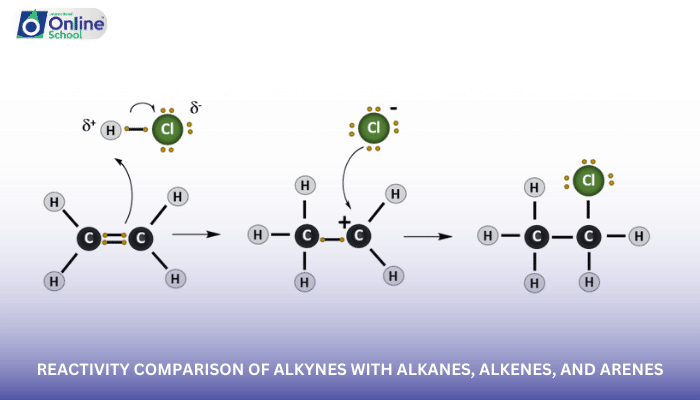
Arenes, such as benzene, are characterized by their aromatic stability and resistance to electrophilic addition reactions. Alkynes, in contrast, readily undergo electrophilic addition reactions due to their lack of aromatic stabilization.
iv. Factors Influencing Alkyne Reactivity:
Triple Bond Strength: The triple bond in alkynes is stronger than the double bond in alkenes, making alkynes less prone to homolytic cleavage and more selective in their reactivity.
Neighboring Substituents: Substituents adjacent to the triple bond can influence the reactivity of alkynes. Electron-donating groups increase electron density around the triple bond, making it more susceptible to electrophilic attack. Electron-withdrawing groups, on the other hand, decrease electron density, making the triple bond less reactive.
v. Reactivity Patterns of Alkynes:
Hydrogenation: Alkynes undergo catalytic hydrogenation to produce alkenes and eventually alkanes. The addition of hydrogen occurs in a stepwise manner, first forming an alkene and then an alkane.
Hydration: Alkynes can undergo hydration in the presence of acid and water to form carbonyl compounds, such as ketones or aldehydes. The hydration process occurs through Markovnikov addition, where the hydroxyl group (-OH) adds to the carbon atom with more hydrogen atoms.
Acid-Catalyzed Addition Reactions: Alkynes can undergo acid-catalyzed addition reactions with various reagents, such as alcohols, carboxylic acids, and halogens. These reactions typically involve the addition of the reagent across the triple bond, forming new carbon-carbon bonds.
vi. Applications of Alkyne Reactivity:
Industrial Petrochemistry: Alkynes are important intermediates in the production of various industrial chemicals, including plastics, synthetic fibers, and pharmaceuticals.
Organic Synthesis: Alkynes are versatile building blocks in organic synthesis, allowing for the introduction of new functional groups and the synthesis of complex molecules.
Materials Science: Alkyne-based polymers possess unique properties, such as high strength, flexibility, and conductivity, making them valuable materials for various applications.
The study of alkyne reactivity provides insights into the unique properties and reaction pathways of these unsaturated hydrocarbons. Understanding these reactivity patterns is essential for organic synthesis, industrial processes, and the development of new materials with tailored properties. By comprehending the factors that influence alkyne reactivity, chemists can effectively utilize these compounds to synthesize a wide range of valuable products.
